
Water Heater Sizing: A Plano Q&A
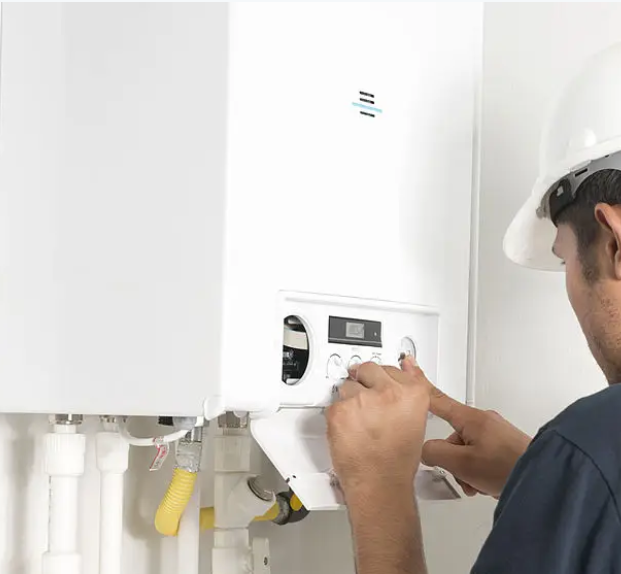
Rather than a generic chart, here are the actual questions Collin County homeowners ask us about sizing — and straight answers to each one.
Q: Is bigger always safer?
No. An oversized tank costs more to buy, takes more floor space, and loses heat to standby losses every hour of every day for a decade, whether anyone uses hot water or not. The goal is matching your real peak-hour demand with a little headroom, not buying the largest unit that fits the closet.
Q: What's the actual number that predicts a good morning shower?
Not the gallon rating by itself — the first-hour rating (FHR), which combines stored volume with how fast the burner or element reheats it. A compact, well-recovering 40-gallon gas unit can keep up with — or beat — a sluggish 50-gallon electric tank when three people shower back to back. For tankless, the equivalent question is flow rate in gallons per minute at your required temperature rise.
Q: What size tank fits my household?
| Household | Gas tank | Electric tank |
|---|---|---|
| 1–2 people | 30–40 gal | 40 gal |
| 2–3 people | 40 gal | 50 gal |
| 3–4 people | 50 gal | 50–65 gal |
| 5+ people | 65–75 gal, or tankless | 65–75 gal, or two units |
Electric is sized a notch larger across the board because an electric element recovers roughly half as fast as a comparable gas burner, so the stored volume has to do more of the work.
Q: Why does my hot water disappear even though the tank "should" be big enough?
Usually because peak-hour demand, not daily total, is what runs a tank dry. Add up your busiest 60 minutes: a shower is roughly 10–20 gallons, a bath 15–25, a dishwasher cycle about 6, a warm laundry load 10–15. Three people showering between 6:30 and 7:15 with the washer running can add up to 50–70 gallons in that hour — more than a 40-gallon electric tank can supply, even though it "sounds" adequate on paper.
Q: Does Plano's water and weather change the answer?
Yes, in two ways. First, incoming supply water swings from around 50°F in January to the 80s by late summer — a tankless unit delivers noticeably less flow in winter, so size against the winter column of the spec sheet, not summer. Second, sediment from the area's moderately hard water settles on a tank's floor over the years and effectively shrinks its usable capacity, so a ten-year-old 50-gallon tank can behave like a 40-gallon one. If a heater that used to be enough suddenly isn't, check for scale with a flush and an anode inspection before assuming you need a bigger unit.
Q: My garage runs hot in summer — does that matter?
It's actually an advantage for a heat-pump electric water heater, which pulls ambient heat from the surrounding air to do most of its work — a warm garage feeds it "free" heat. Heat-pump units recover more slowly in efficiency mode, though, so they're typically specified one size larger than a standard electric tank of the same household fit.
Q: How many showers can a tankless unit really run at once?
Add the flow rates of the fixtures you want running together — a shower is roughly 1.8–2.5 gpm, a kitchen faucet about 1.5 gpm, a washer 1.5–2 gpm. At Plano's winter inlet temperature, a well-matched residential gas tankless unit typically covers two simultaneous showers comfortably; three fixtures or a soaking tub usually calls for a larger unit or a second one.
Q: How do I get a size recommendation for my specific house?
Send a photo of your current unit's rating plate along with household size, bathroom count, and appliance habits through our free quote form. You'll get a sizing recommendation and quote with no obligation, and can compare it against our tank vs. tankless guide.
More From the Blog
- Water Heater Replacement Cost: A Plano Buyer's Checklist
- Repair or Replace? A Plano Homeowner's Decision Guide
- Tank vs. Tankless in Plano: Side-by-Side Comparison
- How Long Will My Water Heater Last? A Plano Timeline
- Gas or Electric? Answering It for Your Plano Home
- Water Heater Leaking? Follow This Order of Operations
Get a Free Water Heater Quote
Describe your water heater situation and we will send you a quote with no obligation.
Get Your Free Water Heater Quote
Tell us what you need and we will call you back — no cost, no commitment.